Table of Contents
Is Tunisia a budget-friendly destination?
Tunisia is one of the most affordable destinations in the Mediterranean region. Compared to Spain, Italy, or Greece, daily costs here run considerably lower and compared to Morocco or Egypt, Tunisia holds its own as genuine value for money. A thoughtful budget traveller can cover accommodation, food, local transport, and entry fees to major attractions for around €25–35 per day. Mid-range travellers spending on private rooms, restaurant dinners, and guided excursions are looking at €60–100 per day.
This guide breaks down the real numbers across every category, with practical advice on stretching your budget further without missing what Tunisia does best. Tunisia rewards travellers who plan with cost awareness in mind, and there is plenty to experience without spending heavily to get it.
And ultimately, is Tunisia cheap to travel to? By most European standards, yes, noticeably so.
Tunisia food and drink prices
Tunisian food is one of the quiet pleasures of travelling here, and eating well costs very little if you follow where locals eat. Street food and neighbourhood restaurants are the best value and often the best food.
Street food and local cafés
A brik (crispy pastry filled with egg, tuna, or cheese) from a street stall costs 1–3 TND (under €1). A bowl of lablabi, the warming chickpea broth that Tunisians eat for breakfast, runs 3–5 TND. A coffee at a local café is 1–2 TND. Casual sit-down lunches at neighbourhood restaurants typically cost 8–15 TND per person (roughly €2.50–5).
Restaurant dining
Tourist-facing restaurants and hotel dining rooms push prices higher, expect 30–60 TND per person for a full meal with drinks. These can be good, but you’ll eat more memorably and spend less by choosing places without laminated picture menus. Walking one street further than the obvious tourist strip almost always reveals something better.
Local insight: Avoid places that display prices in euros rather than dinars — these are calibrated for tourist spending, not local value. Our team at Verdi Tunis Beach Resort can point you toward the right spots depending on where you’re headed. |
For neighbourhood-by-neighbourhood restaurant recommendations in Tunis, our guide to the best restaurants in Tunis for authentic Tunisian cuisine covers the places worth seeking out.
Transport costs and budget options
Getting around Tunisia is affordable across every mode of transport. The key is knowing which option suits which journey; the price differences between them are significant.
Trains
The SNCFT rail network connects Tunis with Sousse, Sfax, Monastir, and several other cities. Trains are clean, comfortable, and well-priced. A second-class ticket from Tunis to Sousse costs around 7–10 TND (roughly €2–3). For longer routes in peak season, booking a day or two ahead makes sense as seats fill.
Louages (shared long-distance taxis)
Louages are how most Tunisians travel between towns. They depart from fixed stations when full, run frequently throughout the day, and cost very little. Tunis to Hammamet runs around 5–8 TND. They’re a little spontaneous, you turn up, find your route, and wait a short while, but they’re fast and characterful. This is the most budget-efficient way to cover long distances.
City taxis
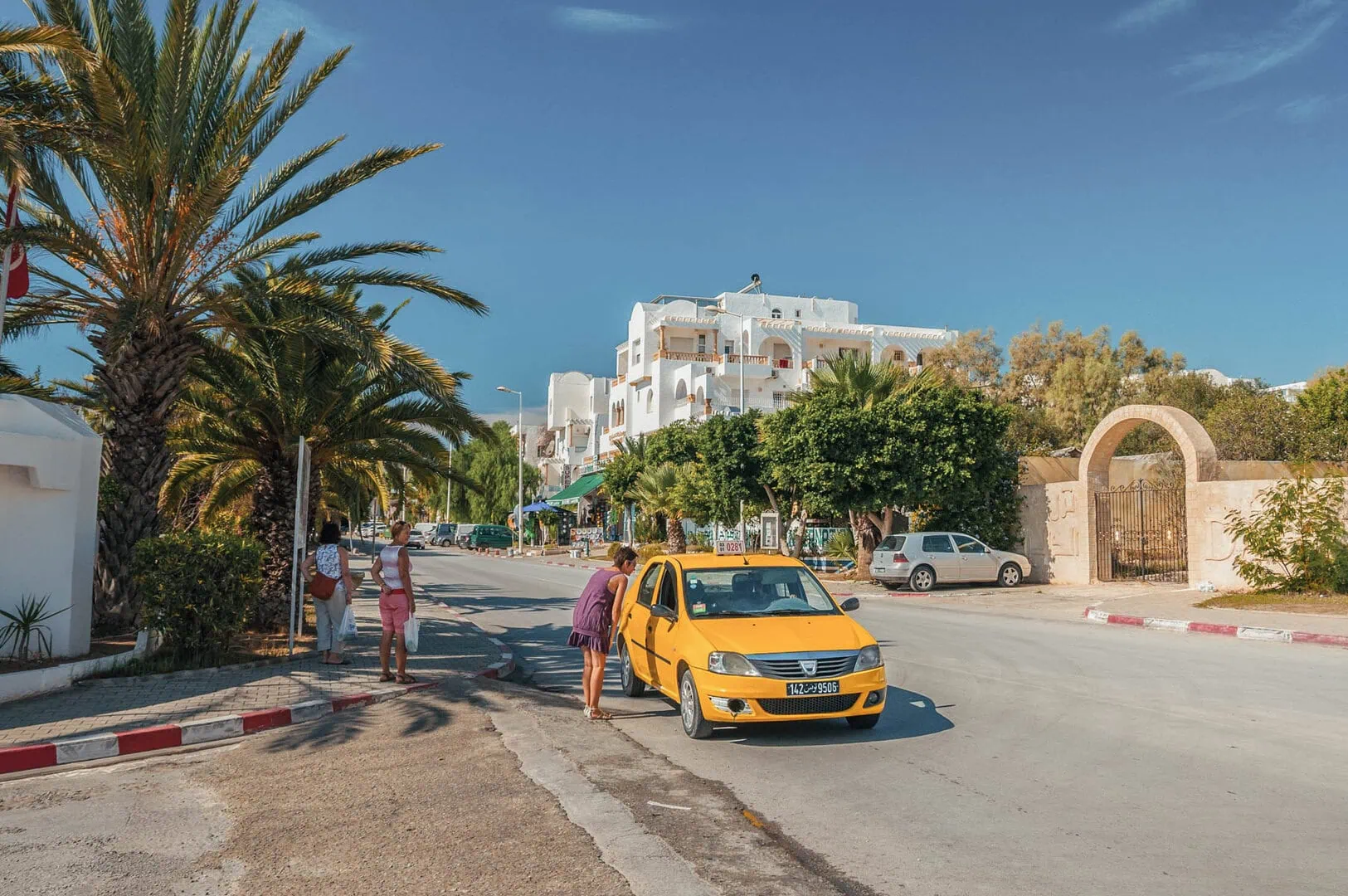
Yellow metered taxis in Tunis and other cities are reliable and inexpensive by any standard. A typical in-city journey costs 3–8 TND. Always confirm the meter is running when you set off. For airport transfers and day trips, our team can arrange trusted private drivers, just ask at reception.
Buses
SNTRI operates intercity coaches connecting major cities. Tickets cost 10–20 TND for most routes. Buses are slower than louages and trains, but air-conditioned and good for budget travel where time isn’t the priority.
Transport Type | Typical Cost (TND) | Approx. Cost (EUR) | Best For |
|---|---|---|---|
City taxi (short journey) | 3–8 TND | €1–2.50 | Getting around cities quickly |
Louage (intercity) | 5–15 TND | €1.50–5 | Budget intercity travel |
Train (2nd class) | 7–18 TND | €2–6 | Comfortable longer journeys |
Intercity bus (SNTRI) | 10–20 TND | €3–6.50 | Budget travel, more time |
Rental car (per day) | 80–150 TND | €25–50 | Exploring remote areas |
For a full breakdown of routes, timings, and how to use each mode, our Tunisia public transportation guide covers everything you need to plan your routes.
Attraction and activity prices
Tunisia’s headline attractions are excellent value. Entry fees to archaeological sites, museums, and historic medinas are low by international standards, and several of the most memorable experiences cost nothing at all.
Attraction | Entry Fee (TND) | Approx. Cost (EUR) |
|---|---|---|
Bardo National Museum, Tunis | 12 TND | ~€4 |
Carthage archaeological sites | 8–12 TND per site | ~€2.50–4 per site |
El Jem Roman Amphitheatre | 12 TND | ~€4 |
Tunis Medina (UNESCO) | Free | Free |
Sidi Bou Said village | Free | Free |
Dougga Roman ruins | 12 TND | ~€4 |
Guided Sahara day tour (from Douz) | 80–150 TND | ~€25–50 |
The Tunis Medina, Sidi Bou Said, and most beach areas are free to enter, and these are among the most rewarding parts of any Tunisia trip. Guided tours add context and make sense for first-time visitors to complex sites like Dougga, but self-guided visits are entirely viable at most locations.
For ideas on how to fill your days, our guide to the best things to do in Tunisia and our 7-day Tunisia itinerary both help you plan around your priorities. You can also read more about the country’s remarkable heritage in our guide to Tunisia’s rich culture and enduring traditions.
Sample daily budgets
Here are three realistic daily budget ranges for Tunisia, based on different styles of travel. All figures assume you’ve already covered your flights.
Budget Level | Daily Spend | What’s Included |
|---|---|---|
Shoestring | €15–25 | Hostel dorm or budget guesthouse, street food and local cafés, public transport only, free attractions |
Mid-range | €45–80 | Private room in a hotel or riad, restaurant meals, mix of public transport and taxis, paid attraction entry |
Comfortable | €90–150 | Quality hotel (e.g. Verdi Tunis Beach Resort), restaurant dining, private drivers for day trips, guided tours |
Most travellers find the mid-range bracket covers a very comfortable and rewarding trip, meals at proper restaurants, comfortable accommodation, and the freedom to take taxis when the louage network doesn’t serve your exact route.
Money-saving tips for Tunisia
The biggest savings come from a handful of consistent choices, not dramatic compromises.
- Use louages for intercity travel. They’re faster than buses, cheaper than trains on most routes, and give you a genuine sense of how Tunisians actually move around the country.
- Eat where locals eat. Markets, neighbourhood restaurants, and street stalls offer better food at a fraction of the price of tourist restaurants. Ask your hotel team where they’d recommend.
- Carry cash. Markets, smaller restaurants, and transport hubs run on cash. Having small notes (1 and 5 TND denominations) avoids change difficulties and keeps transactions smooth.
- Visit key sites on weekdays. Entry fees are fixed, but guides and tour operators occasionally offer better rates mid-week. Weekdays also mean fewer crowds at popular spots.
- Buy a local SIM at the airport. Ooredoo and Tunisie Telecom both offer affordable prepaid data plans. A week’s worth of data costs very little and removes the risk of roaming charges.
- Group your Tunis-area sites. Sidi Bou Said, Carthage, and La Marsa are all accessible on a single metro line from central Tunis. Combining them in one day cuts both travel time and transport costs.
- Check for combination tickets. Some archaeological sites in the Carthage area offer combined-entry deals covering multiple ruins for less than buying them separately.
Local tip from our team: The Tunis Metro Line 2 (TGM) runs from Tunis Marine station along the coastline through La Goulette, Carthage, Sidi Bou Said, and La Marsa. A return journey costs under 2 TND. It’s one of the best-value travel experiences in the country. |
When Tunisia may cost more
Tunisia’s affordability is real, but there are scenarios where your daily spend will rise. Planning around these keeps expectations accurate.
Peak season travel (July–August)
Accommodation prices climb in July and August, particularly in coastal resorts. Popular guesthouses and mid-range hotels can cost 30–50% more than the same rooms in April or October. Booking ahead helps, but the prices themselves are a fixed feature of peak demand.
Guided tours and Sahara excursions
Organised day trips to the Sahara, Dougga, or Matmata add significantly to a day’s budget. Expect to spend €25–60 per person for a full guided excursion from Tunis or the coastal resorts. These are worth the cost for first-time visitors to complex sites, but they’re a meaningful daily budget item.
International or tourist-facing restaurants
High-end restaurants in Tunis, Sidi Bou Said, and Hammamet price at European-adjacent levels — around €25–50 per person for a full meal with wine. These are occasional treats rather than daily spending, but worth budgeting for if fine dining matters to your trip.
Car hire
Rental cars open up remote areas like the Chott el-Djerid, the Ksour region, and the Dorsal mountain range that public transport doesn’t easily reach. Daily hire costs run 80–150 TND (€25–50), plus fuel. It’s worth it for the flexibility, but it adds up over a longer trip.
Final thoughts on travelling Tunisia on a budget
Tunisia stands out among Mediterranean destinations for one reason that matters for budget travellers: the value doesn’t come at the expense of the experience. You can stand inside a Roman amphitheatre with almost no one else there, eat food that has been made the same way for generations, and wander a UNESCO medina without paying a penny to enter. The country offers rich culture, extraordinary history, and diverse landscapes, and you can access most of it without spending heavily.
The key is knowing where the money goes furthest: local transport over private transfers, neighbourhood restaurants over tourist-facing dining, and well-timed visits that cluster nearby sites. With a little planning, Tunisia is one of the most rewarding and affordable destinations for European travellers.
Accommodation is one area worth investing in because where you stay shapes the local insight and support you have access to. Staying at Verdi Hotels Tunisia puts our team’s knowledge of the country at your disposal, from restaurant recommendations to transport arrangements to the detours that most visitors never find. Tunisia rewards the curious traveller who arrives with a plan and an open mind. Our team is here to help you build both.
Plan your Tunisia trip with Verdi
Stay at Verdi Tunis Beach Resort and travel with a team that knows Tunisia well. We’ll point you toward the experiences worth having, and help you find them for less.